
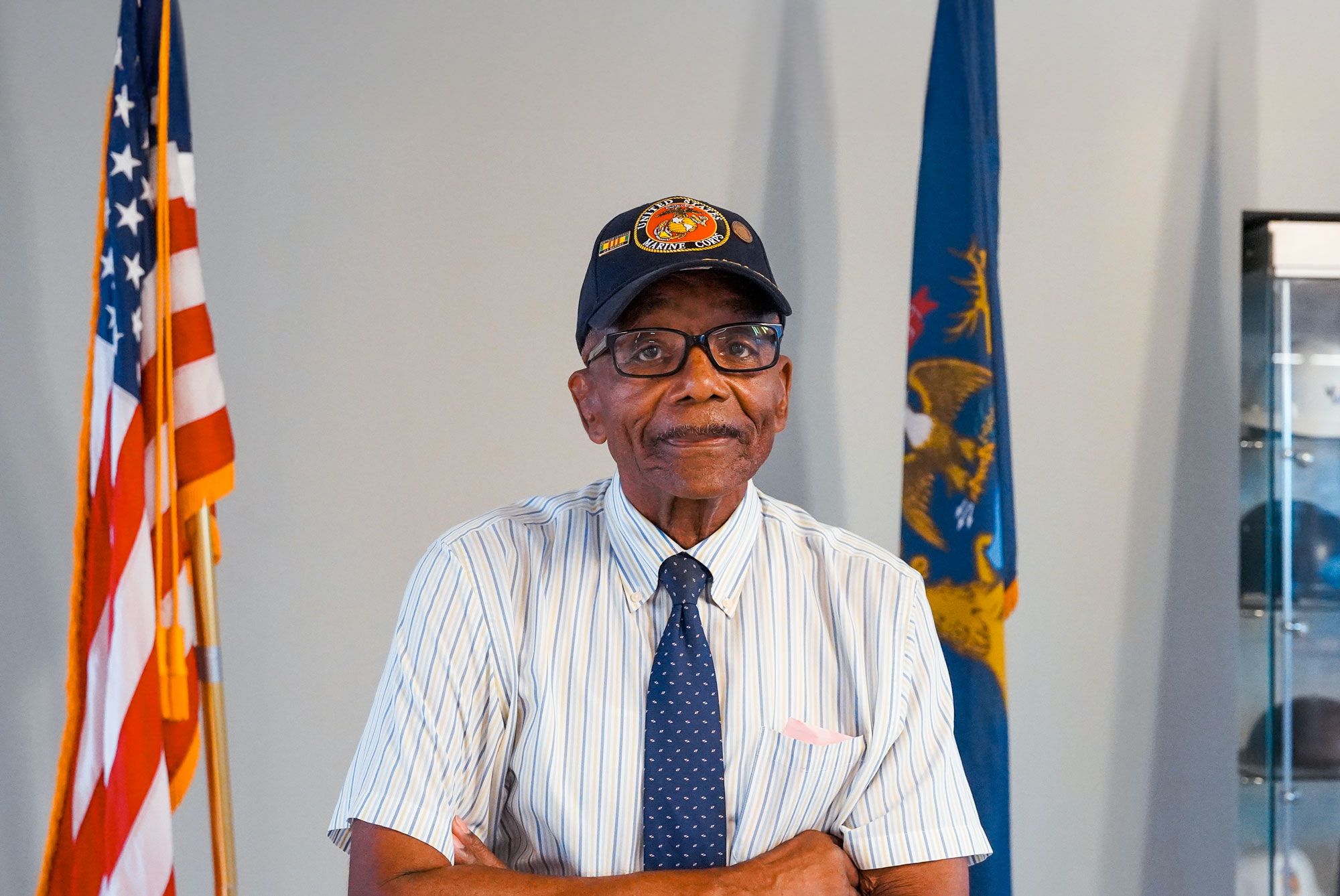

Ray Lamont Williamson has spent much of his life helping people find their footing.
He has listened to people in crisis, connected neighbors with health care, helped veterans navigate housing and employment, and sat with people as they worked through the difficulties of living together. At Michigan Veterans Foundation, where he has served since 2009, that work continues. Williamson monitors five community houses, leads transition classes, brings service providers into the room, and helps veterans take practical steps toward independent living.
He does not describe it as a grand calling. He describes it as meaningful work, something that keeps him busy and gives him the chance to see people get it right.
That quiet way of putting it reflects a lesson Williamson says has taken him a lifetime to learn: “If you just focus on doing the right thing, you can’t lose by doing that.”
A decision made at 18
Williamson grew up in Detroit in a large family. He was one of eight children, though he remembers families in his neighborhood with many more. His father had served in the Navy during the First World War, and military service was part of the family’s history.
In May 1966, shortly after turning 18, Williamson was drafted. He could have followed the path laid out for him, but something caught his attention when he visited the downtown induction center. He saw the Marines’ uniform and decided to learn more.
That choice led him to the Marine Corps.
“I’m a survivor,” he says of those early days. He remembers the adjustment: the intensity, the discipline, and the experience of people getting in his face. His father had given him a sense of what military life might involve, but joining the Marines was its own education.
After training, Williamson received orders assigning him to the USS Hancock, an aircraft carrier. He had never been aboard a ship before. The Hancock was an older carrier with a wooden flight deck. Planes were catapulted from it, and the smell of burnt wood lingered in the air.
“That smell just kind of stayed with me,” he recalls.
Williamson spent two tours in the Gulf of Tonkin during the Vietnam War. His duties included monitoring the brig and guarding a nuclear weapons storage area. He remembers long stretches with very few people in the brig and limited conversation with those who were there. The work was part of a much larger military operation, but his memories hold details that remain vivid: the ship, the wooden deck, the planes launching, and the smell that followed him.
He served for three and a half years. Then he came home.
Finding a different kind of service
Williamson returned to Detroit and tried to move into civilian life. He had a job lined up at Chrysler, but the noise was difficult for him. He left and went back to school, using government education benefits. When he lost those benefits, he began looking for another way to continue his education and build a life after service.
Someone suggested that a nonprofit might be able to help pay for school. Williamson says he did not yet know what a nonprofit was. He soon found out.
In the 1980s, he began working with Healthcare for the Homeless. He helped locate people in downtown Detroit and in places where they were living without reliable access to care. He remembers carrying a large phone and going into buildings and alleys to ask whether people needed medical support. The organization connected people with health care and other resources during a period when HIV and AIDS were beginning to reshape public health work.
The job called for patience and presence. It meant meeting people where they were, hearing what they needed, and helping them reach someone who could provide it.
Later, Williamson worked for a suicide prevention center, where he spent 16 years answering calls and connecting people with agencies. He also worked in health care, maintaining the relationships that would eventually bring him into contact with the Michigan Veterans Foundation.
That connection became personal and lasting. When Williamson was at risk of losing his position at a health care facility, MVF’s leadership offered him a job. The question was when he could start.
“What about tomorrow?” Williamson replied.
He joined the Foundation in 2009. He has been there ever since.
The example he carried with him
Williamson traces his instinct to help others to his mother.
“She was like a social worker before I knew what a social worker was,” he says. People in the neighborhood called her “Mother.” They knew she was someone to turn to, someone who could point them toward help and often knew where to find it.
Williamson remembers her as a person with resources, relationships, and a steady presence in the community. His brother also spent years working with children. In different ways, the two brothers carried that example forward.
For Williamson, service is not limited to a job title or a single organization. It is a way of showing up for people, whether that means helping someone find care, talking through a conflict, or encouraging a person to take the next step toward a more stable life.
He has seen the value of that support from both sides. When he came home from the Marines, he says, he was not the same person who had left. He had not yet put alcohol down. Someone helped him do that.
That memory stays close to the work he does now. He knows that a person’s path forward may depend on someone else being willing to listen, offer a resource, or stay present through a difficult season.

Helping veterans build a life they can maintain
At MVF, Williamson’s work stretches across the practical details of transition.
He monitors five houses in the community and helps residents work through the challenges of shared living. Living with others requires patience, communication, and an understanding that common areas belong to everyone. When tension rises, Williamson listens to each person and helps them return to the agreements they made when they entered the home.
There is no house monitor overseeing every moment, he explains. Residents have to learn how to share space and address conflict. Williamson can offer guidance, but the goal is to help veterans manage the situation and build the skills they will need as they move forward.
The work can be as simple as sitting down and hearing both sides. Sometimes it means reminding people that they made a commitment to live together respectfully. Sometimes it means letting them know he is available if they need someone to talk to.
Williamson also leads transition classes several times each year. The classes cover subjects that matter when someone is preparing to live more independently, including time management, money management, and legal assistance. He brings in housing providers so veterans can hear about available homes and understand what different options offer.
Other partners help veterans explore employment, education, health care, and transportation. Michigan Rehabilitation Services may help someone with a disability access education, improve employability, or find transportation to work. Agencies serving older adults may connect eligible participants to employment opportunities or help supplement wages. Wayne State University programs have helped veterans return to school and build computer skills. Williamson has also invited Michigan Works and the local health department to provide information and support.
He does not assume that every veteran needs the same thing. The needs of each class help shape what comes next. Williamson asks participants to identify an issue, concern, agency, or resource that could help veterans move from homelessness toward independent living. Their answers can help guide future sessions.
That approach matters because a home is only one part of stability. Veterans also need the tools, knowledge, income, connections, and support that can help them remain housed. Williamson has seen what can happen when people are placed in housing without enough help to manage money or address the challenges that follow. In his view, the system needs to make it easier for veterans to get what they need and stay on their feet.
“I’m trying to make it easier for veterans to transition back to independent living,” he says.
The moments that stay with him
Ask Williamson about a success story and he does not point to a single measure of achievement. He remembers a person’s face.
One veteran came to the center dealing with mental health challenges and alcohol use. Over time, he left the center and got an apartment. Later, he returned to ask whether there might be a job for him in the kitchen, where he had worked before.
Williamson encouraged him to ask.
There was an opening. The veteran returned to work and stayed in the kitchen for a year or two. Later, a program helped veterans who had found housing get transportation to their jobs. He received a car.
Williamson remembers the look on his face when he got it.
The veteran became more than someone who had received help. He began checking in, asking how things were going, and offering to help other residents. He was someone Williamson could count on.
“He walked through the door like everybody else did,” Williamson says.
That is part of what makes the work matter. A person may arrive needing support, then, with time and the right opportunities, become a source of support for someone else.
Williamson has seen similar transformations in people who found a place to call their own, reconnected with family, or began making amends with their children. He has also seen former residents return to help others. One veteran still works part time, accompanies Williamson on outreach visits, wears his uniform, and helps present the colors at events. He does it without being asked for anything in return.
These are not small things. They are signs of people building a life with room to contribute, to reconnect, and to be counted on.
At nearly 80, still showing up

Williamson will turn 80 on his next birthday. He has tried stepping away from work, but his wife has made clear that he is not quite ready to stay home. The truth is, he enjoys what he does. He likes staying busy. He likes working with people. Most of all, he likes seeing them find their way forward.
A former resident who has been living in his own apartment for six years recently came by Williamson’s office just to talk. He remembered that Williamson had helped him. For Williamson, that visit says what a spreadsheet cannot. The work leaves a mark. A relationship formed in a difficult season can remain meaningful years later, after a person has a home and a life of his own.
When he reflects on what his 80-year-old self knows that his 18-year-old self did not, he returns to simplicity. Doing the right thing, he says, is often easier than the alternatives. When people avoid it, problems can spread into their own lives and the lives of others. Keeping life focused on what is right, he believes, makes it possible to move forward without adding needless complexity.
Williamson’s life has not been without change or difficulty. He has known the challenge of returning from military service, the work of recovery, and the effort of finding a new direction. He has also known what it means to be helped.
Now, at Michigan Veterans Foundation, he offers that same kind of steady presence to veterans working toward their next chapter. He listens. He connects people with resources. He helps them practice the skills that make independence possible. And he keeps showing up.
The goal is not simply to help someone leave a shelter or move into a house. It is to help that person build a life they can maintain, a life with room for work, family, dignity, and the chance to help someone else. Williamson has spent decades helping make that possible. When asked why he continues, his answer is straightforward: he enjoys seeing people get it right.
For the veterans finding their footing, that steady belief can make all the difference.