
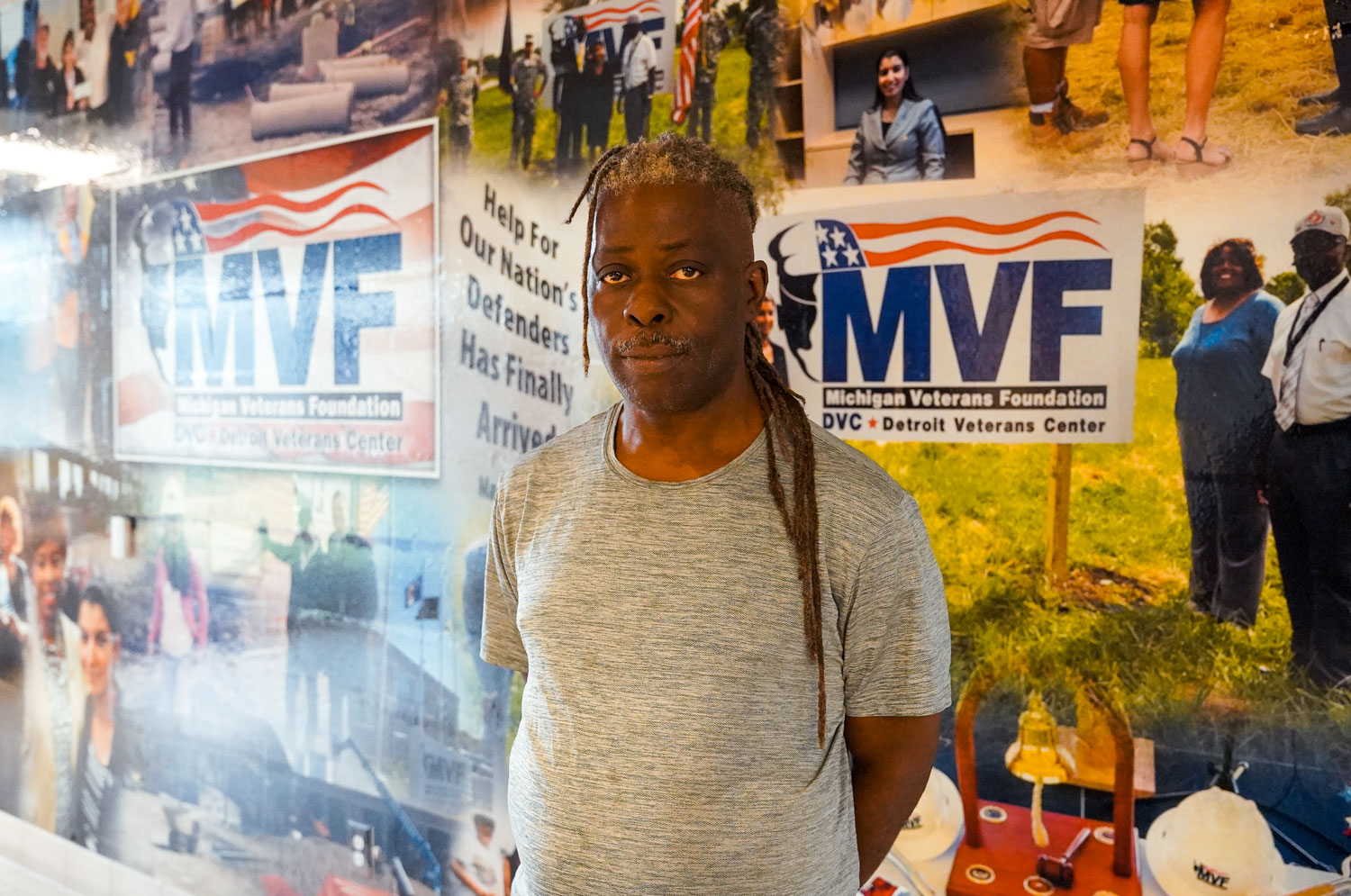
“I’d be in jail right now if it hadn’t been for this place.”
When Harry Parker talks about the moment he came to Michigan Veterans Foundation, he does not soften the truth.
A family loss had left him in a painful situation. He does not want to share the details, and he does not have to. What matters is what happened next: Parker found MVF, met people willing to help him, and began to get back on his feet.
Today, he works for the organization as a maintenance employee. He also lives in one of MVF’s houses. The place he once needed has become a place he helps care for.
That change did not happen all at once. It began with a door open at a difficult time, and with people who saw a veteran in need of support.
A place to begin again
Parker is a Marine Corps veteran and a lifelong Detroiter. He describes himself as a jack of all trades: a chef, a licensed sound engineer, and someone whose creative work has appeared online. He has traveled around the world and returned home to the city where he grew up.
His connection to MVF began years ago, when a childhood friend told him about the Foundation’s former facility. Parker remembers his first experience there as traumatic. He is clear that he would rather not revisit it. Later, when a family crisis brought him back to MVF, the support he found was different. He met MVF leadership and began to see a path forward.
He remembers that help with gratitude. He calls the people who stood beside him a blessing, and he speaks with particular warmth about the staff member whose tireless work, he says, has helped keep the place open.
For Parker, the support was not an abstract promise. It changed the direction his life was taking. It helped him avoid a situation that could have ended in jail. It gave him room to breathe, find stability, and consider what came next.
“Being here has actually helped me get on my feet,” he says.
That sentence carries the weight of what MVF can mean in a person’s life. Support can begin with a safe place to stay, but the larger gift is the chance to move forward with people in your corner.
From receiving help to giving it
Parker now works at MVF as its maintenance person. He lives in one of the Foundation’s houses, a part of the support that helped him regain his footing.
There is something deeply meaningful in that circle. Parker knows the place from both sides. He knows what it is like to arrive needing help, uncertain about what comes next. He also knows what it means to take responsibility for a place that offers that help to others.
His work may happen behind the scenes, but it is part of the daily life of the Foundation. A house has to be cared for. Shared spaces have to function. The place must be ready for the people who need it. Parker’s presence helps make that possible.
His story also resists the idea that accepting support is the end of someone’s contribution. At MVF, receiving help can be one part of a larger journey. A person can regain stability, discover new purpose, and find ways to serve others in return.
Parker’s experience has given him a strong sense of what the Foundation means to veterans in Detroit. He calls it a beacon and a premier place for veterans to get back on track. He worries about what would happen if MVF closed its doors. The effect, he says, would be catastrophic for people who depend on it.
He speaks with urgency because he has seen the need up close. Veterans come home carrying experiences that are difficult to explain and even harder to leave behind. Parker believes people need to understand the commitment behind raising a hand to serve, and the lasting impact that service can have.
“You just have to understand that these people have gone through some things.”
There is no easy phrase that can contain every veteran’s experience. There is no single story that represents them all. But Parker asks people to listen, to recognize that veterans may be carrying more than the public can see, and to support the places that help them find their next step.
A future with room to move
Parker’s path into the Marine Corps was not a conventional one. He joined at 32, after taking the ASVAB during a difficult stretch in his life. He says he scored 100, then walked out, convinced the Marines would not want him at his age. The recruiters called him back. He learned there was no cutoff for the path he was considering.
The story is unmistakably Parker: a difficult day, a surprising opportunity, and a decision made in a moment when the next chapter was not yet clear.
That sense of possibility appears again in his life at MVF. His story does not erase what brought him there. It shows what can happen when a person in crisis finds support that meets him where he is and gives him space to choose what comes next.
Now Parker helps maintain that space for others.
He wants people to donate and to learn more about veterans’ needs. Support for MVF helps sustain the work that veterans rely on as they rebuild stability and move toward independent living. Parker knows what that support can mean because he has lived it.
He came to MVF at a time when his life could have gone in a very different direction. He found people who helped him get back on his feet. Today, he is part of the team that keeps the Foundation moving.
The place that helped Harry Parker find his way back is now a place he helps keep open for the next veteran who needs a place to begin again.